
Stock nobody trusts
A notebook, a spreadsheet and the till all disagree, so the stock count is a guess by the time anyone checks it.
Centralised business management systems for retail and service operations.
One system, not five spreadsheets. We build centralised ERP platforms that bring inventory, billing, sales and day-to-day reporting into one place — sized to how the business actually operates, with subscription-based licensing when that is the right model for how it is sold.
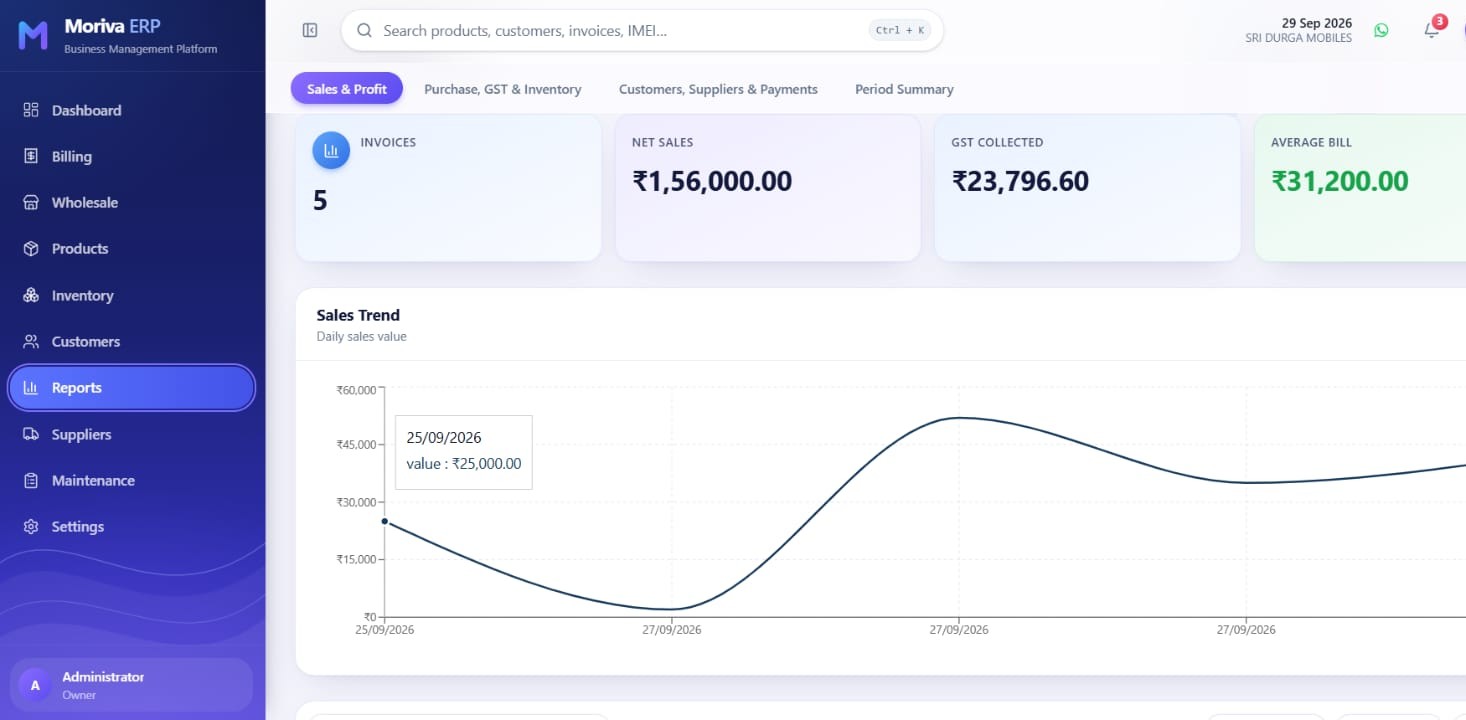
Most small retailers run the business across a billing app, a notebook for stock and a spreadsheet for suppliers — three sources of truth that never agree, and nobody notices until the stock count is wrong.
We build one system instead: inventory, sales, billing and reporting sharing the same data, with access and licensing controlled centrally. The Mobile Retail ERP platform in our portfolio follows exactly this pattern for mobile phone shops.
The patterns we see most often when a business asks us to look at what they have.
A notebook, a spreadsheet and the till all disagree, so the stock count is a guess by the time anyone checks it.
Sales recorded in one place and inventory tracked in another, so nothing updates automatically when something sells.
Owners find out how the week went by asking staff, because there is no single report that already knows.
Every login sees everything, so there is no sane way to hand the system to staff without handing them the whole business.
From the first conversation through to the live build and the support after it.
We map how stock, sales and billing actually move through the business before designing a single screen.
A single, live record of what is in stock, updated automatically as sales and purchases happen.
Invoicing and billing wired directly into inventory, so a sale updates stock without a second step.
Sales, stock and performance visible at a glance, instead of assembled by hand at month end.
Access governed by subscription plan and licence validity, so the platform can be sold rather than just used.
The system shipped, staff onboarded, and documentation handed over so it is not dependent on us.
The same standards, scoped to what the business actually needs right now.
Inventory, billing and reporting for one shop, replacing the spreadsheet-and-notebook mix most retailers start with.
The same system extended across locations, with reporting that rolls up rather than staying siloed per branch.
An ERP built to be sold to other businesses in the same trade, with subscription licensing built in from the start.
The same eight stages behind every build on this page — scaled up or down to fit the project, so you always know what comes next.
Clarify the business goal, the people who will use it and how success gets measured — before any interface or stack decisions.
Map the journeys, content structure and enquiry paths so the product is organised around how customers actually decide.
Settle data models, access rules, integrations and hosting, along with the non-functional requirements that shape them.
Build a coherent visual system and high-fidelity screens, reviewed with you before a line of production code is written.
Ship working slices of the product with code review, a demo at the end of each sprint and continuous integration behind it.
Wire up third-party systems, harden access and security, and test the critical flows against real data before launch.
Deploy to production, watch load times, finalise metadata and sitemaps, submit through Search Console and train your operators.
Monitor the live product, fix what surfaces in real use, and plan the next round of work against what the data shows.
Part of how the work is done, not upsells after launch.
Stock levels update the moment a sale or purchase is recorded, not at the next manual count.
Invoices generated against live stock and pricing, with tax handled as part of the flow.
Owners, staff and administrators each see what their role needs, enforced on the server.
Plans and licence validity control access, so the platform supports being resold or tiered.
Sales trends, stock position and billing summaries drawn from the same live data.
New modules and workflows added to the same system as the business grows, rather than bolted on separately.
That is usually the point. Inventory, billing and reporting move into one system, so the same number is correct everywhere it appears.
Every build on this page draws on the same set of services, kept inside one small team rather than spread across vendors.
From idea to impact — we're here to turn your vision into long-term value.